Andrea Rogan’s parents bought this generous plot of land and built a modest timber cottage here back in the 1970s. A garage followed, later converted into overflow accommodation to host their seven children and subsequent sprawl of grandchildren. For decades, it formed the backdrop to the family’s holidays, but when the upkeep became too much for her mother to manage alone, she sold the property on to Rogan and her husband, Simon Richards. “After selling our town home, we shifted in – temporarily,” says Rogan. Beloved as it was, the A-frame was never intended for full-time living, so the couple collaborated with Amelia Nuku, director at architecture studio Nuku, to plan and build their forever home next door.
It was to be a house for two that could expand when their large, multi-cultural family descended. Both Rogan and Richards had non-negotiables. For her: a home that opened to the site, could be enjoyed year-round, had strong indoor/outdoor flow and a separate space for guests. For him: a very big garage. “They wanted the home laid out across two wings, with living and guest spaces down one side and their private quarters on the other,” recalls Nuku. “So two pavilions came naturally into play.”
What’s emerged is a home calibrated to the cadence of daily life and to its Central Otago setting. Rogan and Richards, fond of mid-century modern design, brought a few minimalist references into early conversations. Nuku was discerning in her translation, picking up on elements that worked for the home, the site and the climate. The clean, minimalist northern face and exposed cross bracing, for instance, hark back to the era's sharp lines. But the traditional forms and rooflines of that time wouldn’t do the place justice. Instead, it features a unique profile that suited the landscape and allowed Nuku to capture one crucial view.
“The high window in the living area gives a snapshot of the mountains,” says the designer. “It draws beautiful western light down into that living space, but from the hallway it also functions like a wee framed picture of Mount Roy.” It’s a lovely little moment that informs the angular, off-centre ceiling, giving the room its sharp, sculpted profile. Builder Phil Rogan, of Aspiring Homes, laid out the stained plywood pieces like a jigsaw before they went up. “We were working with quite raw, industrial materials inside, so we wanted to bring a bit of warmth in with that timber,” Nuku explains. “Andrea and Simon had come from quite a traditional home, so there were a lot of new elements – like the ceiling and roofline – that pushed them out of their comfort zone. But they took it all on and really trusted the process.”
Resource consent largely dictated the home’s placement right at the back of the site, but Nuku used the constraints to her advantage. That north-facing living and kitchen spills out to the sprawling lawn through two enormous glazed sliders, while the primary bedroom is tucked away in the other pavilion to the west. Even when the home’s packed with family and the grandchildren are letting loose on the front lawn, the couple can retreat to their room, politely cordoned off by a little garden. “That planting buffer gives privacy to the bedroom so they can be in there with their doors wide open and reading a book. Connected to the land, but disconnected from what’s going on,” says Nuku.
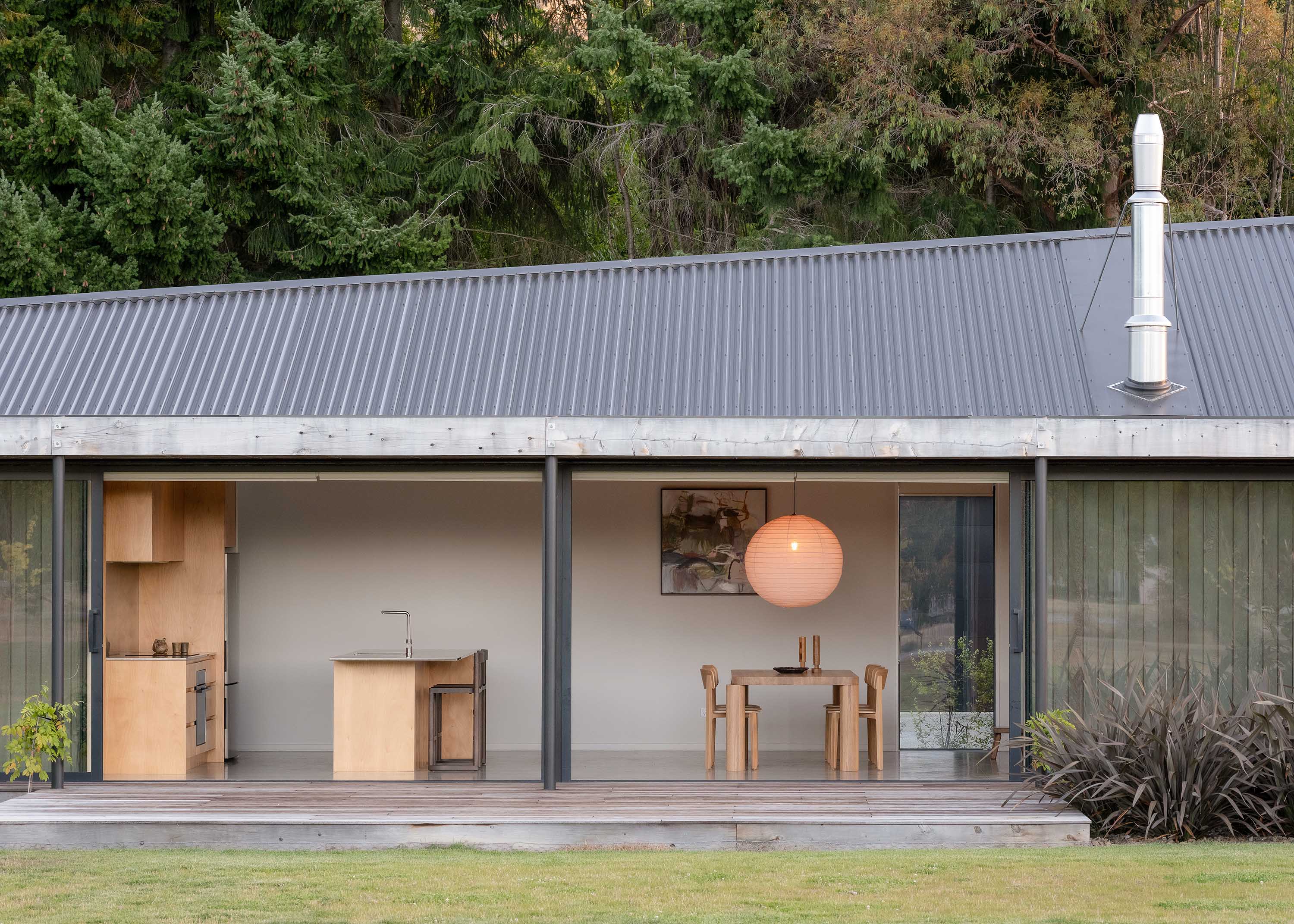


Materially, the home balances looks with logic. The timber cladding was a client-led decision, as the couple’s previous home was cedar and had stood up well against the Wānanka weather. Its tone blends nicely with the earthy browns, greys and greens of the surrounding environment, while black corrugate covers the rest of the home, making practical and financial sense. Richards requested his garage be attached to the home, so Nuku wrapped it in the same metal, making it read as a continuation rather than an afterthought.
Climate considerations are naturally woven into the design: an underfloor-heated concrete slab, thermally broken window joinery, and sensible orientation to the sun. But the big architectural play is the pergolas. On the northern face, slatted timber tempers the harsh summer sun but welcomes in generous winter light. Above the western deck, there’s no slatting; instead, Rogan has planted wisteria, which will slowly grow up and along the timber frame. The pretty, leafy plant will provide summer shade, while in winter, bare vines will let the light in. The home has already proved itself across all seasons. “The fireplace is really just for looks at this point,” says Rogan. With its slim steel hearth stretching beneath the fireplace as a wood store, seat and shelf, it certainly delivers in the looks department.
The interiors are pared back with warm elements and subtle mid-century notes, most evident in the kitchen, built by Rod Askin of Kitchens Direct Wanaka. Nuku designed the space in step with Rogan’s habits as the main chef in the household. “She’s incredibly organised, so we arranged the kitchen to support that,” says Nuku. The cookspace is well proportioned for a two-person home. Its hidden scullery absorbs all of the practical clutter and allows the main space to remain calm and clear. “The materials in that kitchen will allow it to take plenty of wear and tear over the years, while always remaining neat and tidy,” the designer continues. “We designed it in that way so she could relax.”
In truth, the entire house operates on that principle. “I wanted it to feel calm, welcoming, lived in, and embedded in the site,” says Nuku. “Nothing precious, very low key.” And it is. There’s an easygoing atmosphere, more like a holiday house than a permanent home. “Honestly, I was really comfortable in the wee A-frame,” admits Rogan. “And even when it was time to move in here, I was a little hesitant to leave it behind. But what surprised me was that, although it’s beautiful and brand new, it carries the same feeling as the old one. Very relaxed, very easy.” It’s a continuation of the family’s story on the site, rather than a fresh start. The home reads as an evolution: a familiar feeling given new form.


1. Entrance
2. Bedroom
3. Bathroom
4. Scullery
5. Kitchen
6. Dining
7. Living
8. Deck
9. Ensuite
10. Laundry
11. Garage
Related Stories: