Nestled high on the rugged crater walls overlooking Lyttelton Harbour, ceramics artist Cheryl Lucas’ studio exudes the energy of imagination and creation. Every piece is a minor miracle, moulded in clay and brought to life. A highly respected practitioner internationally, Lucas’ practice is distinctive, technically and creatively, but also engages with the full potential of material, narrative, and social commentary.
Lucas grew up on an historic station in Tarras, Central Otago; a dramatic, severe landscape that did much to inform her aesthetic sensibilities. She received her formal training at the Otago School of Art in Ōtepoti Dunedin, graduating in 1975, and a post-graduate diploma in advanced printmaking from Wimbledon College of Art, London in 1979. But it was the context of social change and environmental awareness in Aotearoa that honed her unique perspective on what clay could do and say.
“Finding ways to symbolise my love for rural Central Otago has been selfishly enriching for me,” Lucas reflects. “Maybe some of my works are confronting for some, but I suspect I am not alone in feeling some recognition in my interpretation. I do not think of my pieces as being necessarily about one locality. They are more generalised interpretations than that. It must be remembered that I am just trying to make sense of life.
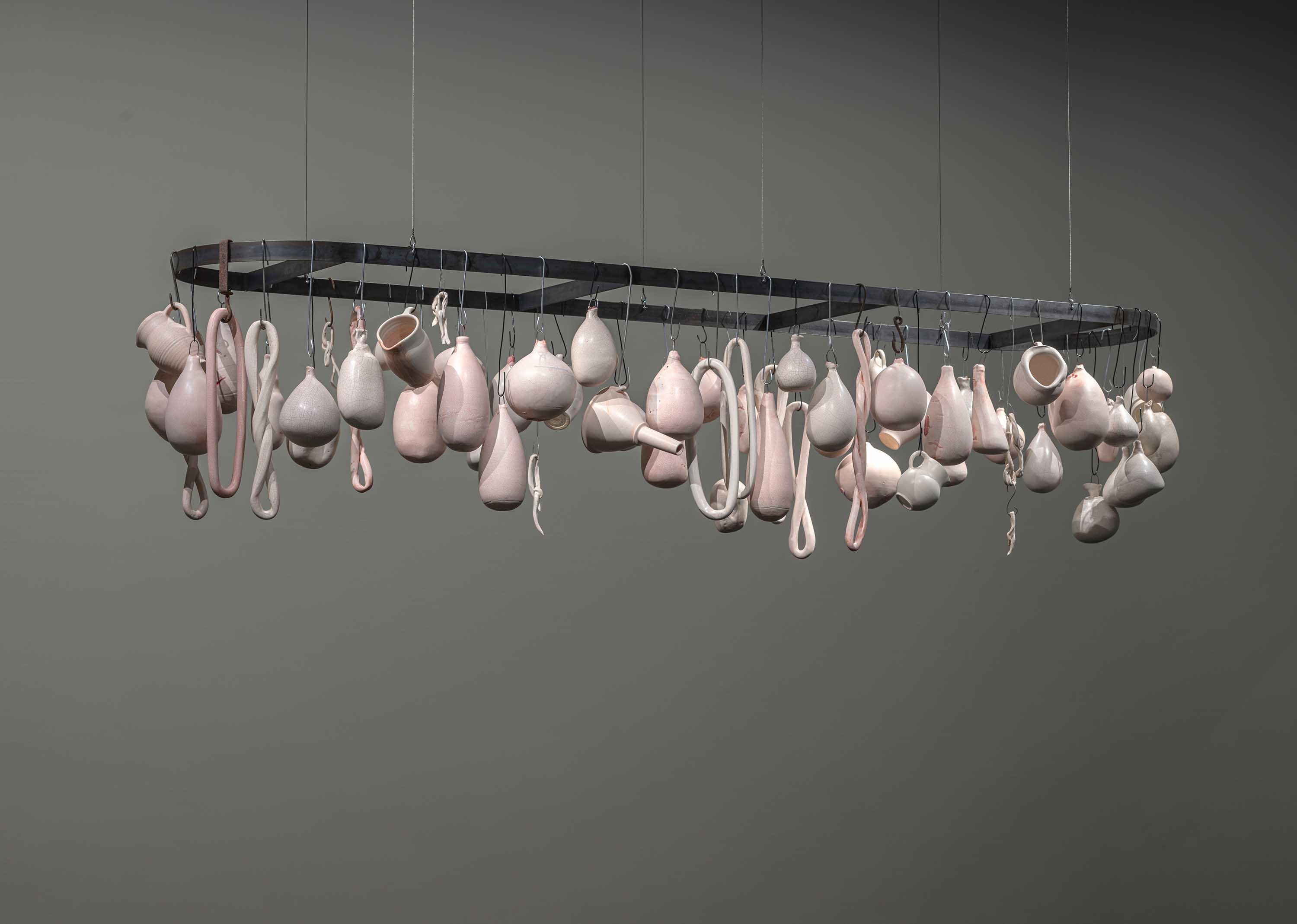
“The earthquakes were the impetus for Harder Larder (2011), intended as a reflection on the inadequacies of modern life, our vulnerability with supermarket dependence which can be shattered in a shake or two. The forms themselves were a nod to on-farm food self-sufficiency and storage.” The earlier Skin Fence, 2008, was prompted by a memory of Lucas’ father “borrowing a kitchen jug for a farm concoction, rendering it unfit for further domestic use, and the fence lines of rabbit pelts from the rabbiter’s tallies.” Here the jug is a symbol of plenty, “once full, now depleted, not unlike the rabbit-stripped land”.
Lucas’ formal training had only included two years of clay work, with Doreen Blumhardt, Michael Trumic and Lawrence Ewing, but was mostly concentrated on drawing and lithography. She returned to clay in 1980 while teaching at Hornby High School in Ōtautahi Christchurch. At the time, Lucas and her husband Peter Rough were living in Tai Tapu, and there she built a kiln. The 1981 exhibition Image & Idea: A View of Contemporary Ceramics in Britain at what is now Christchurch Art Gallery Te Puna
o Wai Whetū, and John Houston’s book The Abstract Vessel, encouraged Lucas to push beyond the functional, and work on forms and surfaces.
In 1987, Lucas and Rough settled in Lyttelton, the sleepy port town connected to Christchurch by an umbilical tunnel through the Port Hills. The place has a bohemian reputation and is a haven for creatives. From her hillside studio, the artist began experimenting with the limits of clay, glaze and form. The shapes of domestic ware transitioned to something more sculptural that challenged received perceptions about ceramics. “The decade from 1987 to 1997 was the toughest,” says Lucas. Her experimental work didn’t fit easily into the category of either craft or art. A breakthrough came in 1999 when Christchurch gallerist Grant Bambury elected to represent her.
Lucas’ signature “flung pots” use physical force – throwing, stretching, squashing – to distort traditional forms into something deeply considered, still recognisable, but spontaneous and expressive, recalling the unpredictable and ever-changing views of Lyttelton, embodying gesture, memory and time. Titles like Dodgy Import and Portside Shuffle suggest a wry engagement with the town’s port culture.
“I love living overlooking the port,” says Lucas. “I love the long view and the feeling of being surrounded by the Port Hills. I am not, unlike my husband, a sailor. I am curious about how the port works, the coming and going of ships and of the small craft that are affectionately named. I see the port as an eye to the rest of the world. This being the case also gives me cause for concern should there be a live import that is undesirable. Dodgy Import and Bug Mantis both referred to this idea. Portside Shuffle was a nod to the cranes which silently move along the wharves like giant creatures shuffling into position.”
Lucas taught ceramics and drawing for many years at Ara Institute of Canterbury, but since 2005 she has focussed on her own practice. Numerous accolades and residencies have followed, including a 2007 residency at the FuLe International Ceramic Art Centre in China. It was after this that she began making installations. A survey exhibition, Shaped by Schist and Scoria, was held at Christchurch Art Gallery Te Puna o Wai Whetū in 2022 to celebrate her four-decade career.
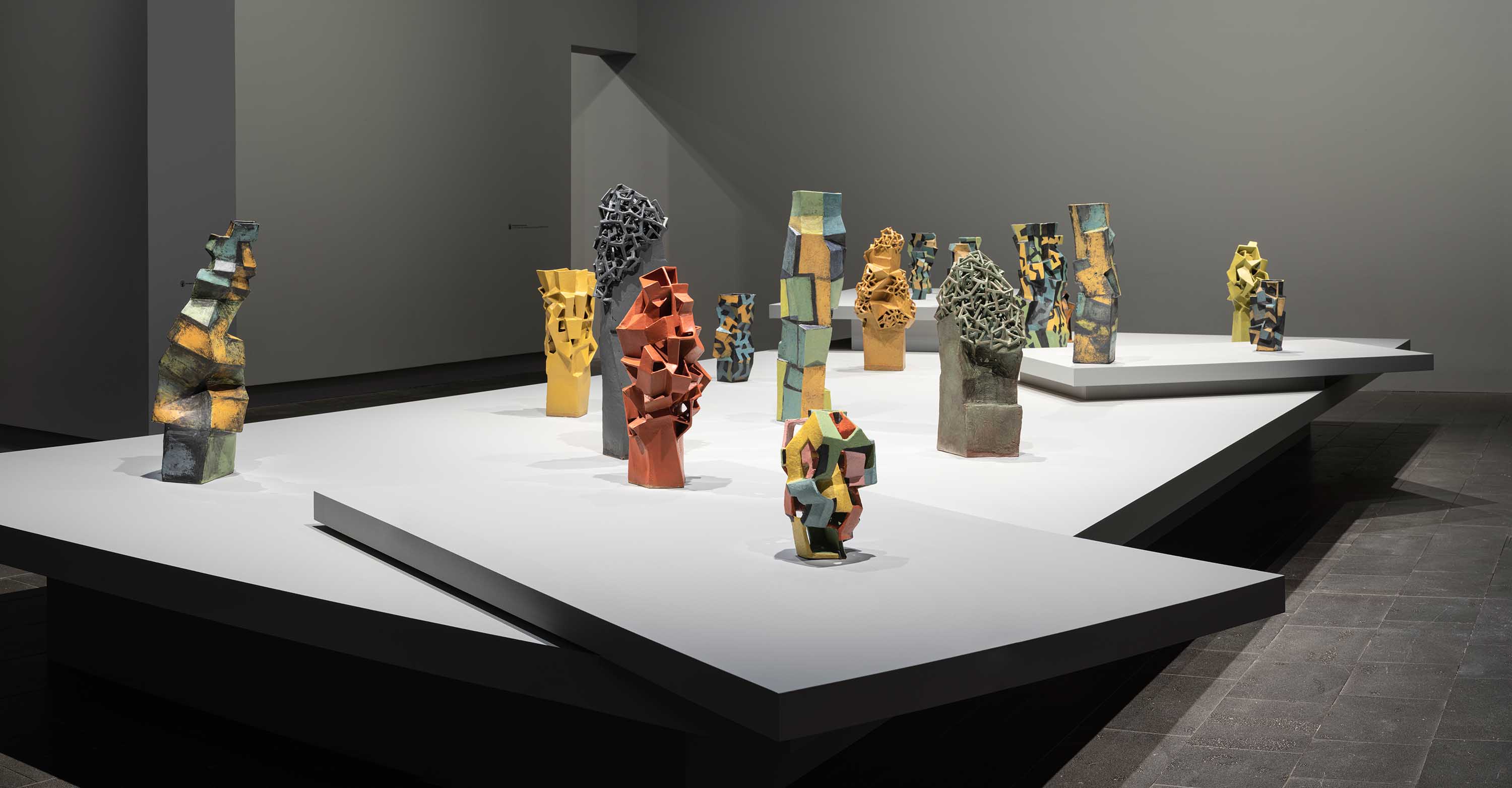


“Idea and concept always dictate process for me,” says the artist. “Pre-Covid, I was thinking about Aotearoa as a place to escape to. I made a series of baches, bunkers and boltholes for the Firing Line exhibition at The National in Christchurch in 2018. These works suited slabs rather than thrown form. Slab-built also suited the angularity of Aotearoa’s divaricating flora, which in turn suited my penchant for compositional devices, and fortuitously extended ideas about protection.” The latter appeared in the exhibition Sod Off at The National in 2020.
“A measles outbreak and a potential influx of crop-destroying insects directed my thoughts to also protecting Aotearoa from pests and diseases,” she recalls. Just before Covid-19 she made Unvaxxed and Bug Mantis for the exhibition Professor Tick & Company at McLeavey Gallery in 2020. She extended this idea further in works such as Razzle Dazzle in her solo exhibition Skedaddle at McLeavey Gallery in 2021.
Lucas’ vessels might ironically allude to colonial kitchenware, offal in an abattoir, road cones in post-quake Canterbury, plant forms or architecture. The 2010-2011 Canterbury earthquakes, which devastated much of Lyttelton and Christchurch, deeply affected her and her practice. In the aftermath, Lucas’ work became more overtly political, investigating notions of destruction, reconstruction, and social responsibility, fragility and resilience.
Many of her vessels contain references to domesticity, shelter and sustenance, but they also disrupt these associations with unexpected breaks and emphasised scars, creating the illusion of precarity in her forms. More recent bodies of work, such as Subterfuge and Milkstock, engage with ecological and societal anxieties through forms that echo the thorny, divaricating structures of native plants evolved to fend off browsing Moa, and bodily metaphors.
“I have used the jug as a symbol of bounty and depletion,” says Lucas. “Porcelain is a fragile material, but it is also an enduring material. I first discovered porcelain shards in the tussock-covered hills of my Central Otago childhood.” These were domestic-ware shards discarded by Chinese and European
gold miners in the 1800s and they speak of the resilience of clay and the lives of the miners. “Continuing to make ceramics after the unspeakable destruction of the earthquakes was like offering up some hope that we would go on. Maybe it was that early memory that was jogged into action. Even in shard form, there will be a memory of life having happened. My question is always how my work will make sense in a future reveal.”
In the past, Lucas has described ceramics as a “less threatening” medium for confronting difficult truths, balancing material and aesthetic seduction with discomfort in her practice. “As a maker,” she says, “I do feel a sense of responsibility for the pieces I make in both what they may convey and in their environmental footprint. Of course, I cannot and don’t believe I could ever dictate the opinions of the viewing public.
“The tactility of the material,” she says, “can be visually seductive and maybe in itself that is a lure. I do believe that it is not the ghoulish that inherently has power. I believe power comes from something subtle and much more elusive.”
Related Stories: